
Hello today I bring you my experience in this semester and everything that this last semester of Phonetics entailed <3<3

Hello today I bring you my experience in this semester and everything that this last semester of Phonetics entailed <3<3
Hello!

Today, with my classmates Francisca Huaitiao, Javiera Farias and I, we bring you our version of the story “The Truly Married Woman”. We hope you enoy it as much as we did!

Citation and Summary
Al-Shallakh, M. A. I. (2024). Embedding artificial intelligent applications in higher educational institutions to improve students’ pronunciation performance. Theory and Practice in Language Studies, 14(6), 1897–1906. https://doi.org/10.17507/tpls.1406.31
Main objective: The article studies how the AI app Elsa Speak can help university students improve their English pronunciation. It also explores what students think about using AI in their learning.
Methodology: The research was done with 12 first-year English students in Jordan. They used Elsa Speak for seven weeks. The researcher compared their pronunciation before and after using the app with tests and a questionnaire.
Findings: Students’ pronunciation scores improved a lot after using Elsa Speak. The average score went from 31.01 to 63.75. Most students said the app helped them speak better and made learning pronunciation easier and more enjoyable.
Elsa Speak is an app that uses artificial intelligence to listen to students’ pronunciation and give instant feedback.
Teachers can use Elsa Speak to help students:
Strengths:
Limitations:
The article shows that AI can make language learning more effective and personalized. It proves that technology can support teachers in pronunciation practice.
Biases:
Teachers could use Elsa Speak as extra practice at home or during class to help students work on pronunciation.
AI will probably make English learning more personalized and flexible. Teachers will guide students in using AI tools to improve faster.
It was surprising that students improved a lot using only Elsa Speak.
Do you agree or disagree with the authors’ conclusions? Why?
I agree with the author that Elsa Speak helps learners a lot; however, teachers are still important because they can explain pronunciation and motivate students better than an app.

Describe their similarities and differences
Platforms: Youtube and TikTok (for Video and photo sharing)
Similarities:
Users:
Differences:
| Category | Youtube | TikTok |
| Video length | Long videos | Short videos |
| Format | Horizontal or vertical | Mostly vertical |
| Focus | Tutorials, vlogs, lessons | Trends, challenges, short explanations |
| Audience | All ages | More popular with teens and young adults |
| Editing | More advanced editing | Fast, filters, effects and music |
| Algorithm | Shows recommended channels/videos | Shows endless content |
| Educational use | Full lessons, documentaries | Quick concepts |
-YouTube and TikTok are video-sharing platforms where users can create, upload, and watch videos. YouTube allows longer videos and works like a digital library where content can be organized into channels and playlists for easy access. TikTok focuses on short, creative videos that are recorded directly in the app using music, effects, and filters. Both platforms use algorithms to suggest content based on user preferences, and they allow viewers to interact through likes, comments, and sharing.
Is it useful for teaching?
Yes, both platforms are very useful for teaching because they support different types of learning. YouTube is great for long lessons, tutorials, and explanations that students can watch and rewatch at their own pace. TikTok encourages creativity and quick learning through short videos, making it ideal for introducing vocabulary, giving examples, and presenting small tasks that keep students engaged. Using both together can create a dynamic and modern learning environment.
Is it useful for communicating and collaborating?
Yes, both platforms improve communication and collaboration among students and teachers. YouTube allows students to share projects or presentations and receive feedback through comments or discussion. TikTok allows interaction through duets, challenges, and videos responding to others, which motivates participation and teamwork. Both tools support student voice, help them express ideas in different formats, and build a sense of community through video communication.
Conclusion
YouTube and TikTok are both valuable digital tools for communication, collaboration, and learning. YouTube supports deeper teaching with longer educational videos, while TikTok encourages creativity and quick demonstrations of knowledge. Together, they create a dynamic way for students to learn, share, and interact in modern classrooms.

Original
Dubbing
To Paula Herrera,Tamara Román and Francisca Marín.
Hello again 💟 here is my review of the fantastic Tamara, Paula and Francisca micro lesson.
⚠️ I’m sorry if you feel offended in a specific moment or part of this review, it’s not my intention to be meen with you girls. And also thanks everybody, for take your time to read it ! ⚠️
This lesson plan focuses on food preferences and helps fifth graders practice the sentence structures “I like / I don’t like / Do you like…?” through listening and speaking activities. It also incorporates technology tools like Canva and Kahoot to make the class more dynamic and interactive. The objective is clearly stated, appropriate for the students’ age, and connects well with their daily lives by using familiar examples of Chilean food.One of the strongest aspects of this lesson plan is its clarity and organization. It follows a logical sequence from the warm-up, to the main activity, and finally to the closure. The use of technology is a great way to keep students motivated and to support different learning styles in the classroom.However, the plan could offer more chances for students to produce longer sentences or speak more freely. The way student progress will be assessed formatively is also not entirely clear.To strengthen the lesson, it would be helpful to include more pair or small-group speaking activities, giving students the chance to practice spontaneous conversation. Providing brief, in-the-moment feedback during class could also help reinforce learning.Overall, this is a fun, engaging lesson plan that successfully promotes participation and active learning among students. So I totally recommended to others, to take your example and apply in a class, because it was wonderful!
I’ll give you ⭐⭐⭐⭐ of 5



Original Version <3
Our Version <3
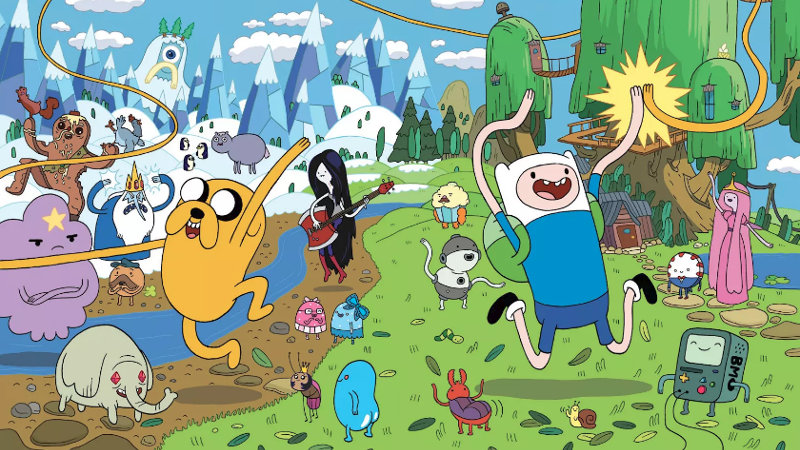
<3Hello!<3
Today, together with my friend Francisca Huaitiao, we bring you a scene from Adventure Time. We hope you enjoy it! See you soon. 😀
OUR VERSION !